⚝ Gas Chromatography Mass Spectrometry (GC-MS)
개요(Overview)
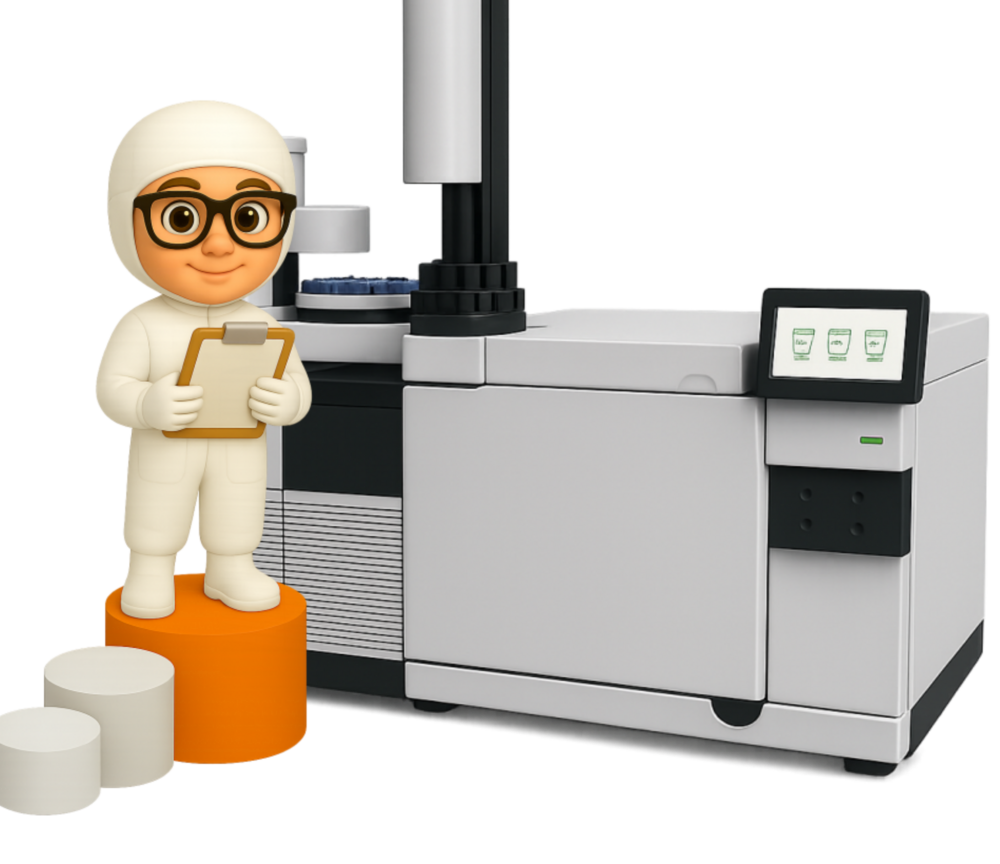
GC-MS(기체 크로마토그래피 질량 분석기)는 기체 크로마토그래피(GC)와 질량분석기(MS)를 결합한 분석 장비로, 복잡한 혼합물의 정성 및 정량 분석을 매우 정밀하게 수행 함.
GC는 혼합물의 성분을 분리하고, MS는 분리된 각 성분의 분자 구조를 분석 함.
Gas Chromatography-Mass Spectrometry (GC-MS) is an analytical instrument combining gas chromatography (GC) and mass spectrometry (MS). It provides precise qualitative and quantitative analysis of complex mixtures. GC separates the components, and MS analyzes the molecular structure of each separated component.
원리(Principle)
샘플은 주입구에서 기체 상태로 기화된 후 운반기체와 함께 컬럼 내부로 들어감.
컬럼에서 샘플의 각 성분이 이동 속도의 차이에 따라 분리됩니다. 분리된 성분이 질량 분석기로 이동하여 이온화된 후, 각 성분의 질량 스펙트럼이 기록 됨.
데이터를 바탕으로 성분의 화학적 구조 및 농도가 정량/정성 분석.
The sample is vaporized in the inlet and carried by the carrier gas into the column.
The column separates the components based on their relative affinities to the stationary phase.
Separated components enter the mass spectrometer, where they are ionized, and their mass spectra are recorded.
Data is used to identify the chemical structure and concentration of each component.
구성 요소 (Components)
기체 크로마토그래피(GC) Gas Chromatography (GC)
주입구(Inlet): 샘플이 기화되어 컬럼으로 전달되는 곳. 일반적으로 Split/Splitless 방식 사용.
Inlet: Where the sample is vaporized and introduced into the column. Typically uses split/splitless injection.
컬럼(Column): 샘플의 성분을 분리하는 역할. 실리카 튜브 내부에 고정상이 코팅되어 있음.
Column: Separates the sample components. Typically, silica capillary tubes with a stationary phase coating.
운반기체(Carrier Gas): 헬륨, 수소, 질소 등 사용. 샘플을 컬럼 내부로 이동시키는 역할.
Carrier Gas: Helium, hydrogen, or nitrogen is used to transport the sample through the column.
오븐(Oven): 컬럼의 온도를 제어하여 샘플 성분을 분리.
Oven: Controls the column's temperature to achieve component separation.
질량 분석기(MS) Mass Spectrometry (MS)
이온화 소스(Ion Source): 분자를 이온화시키는 장치. 전자 충격법(EI), 화학 이온화법(CI) 등이 주로 사용됨.
Ion Source: Ionizes molecules for analysis. Common methods include Electron Ionization (EI) and Chemical Ionization (CI).
질량 분석 장치(Mass Analyzer): 이온의 질량 대 전하 비율(m/z)을 측정.
사중극자(quadrupole), 이중 초점 분석기 등이 있음.
Mass Analyzer: Measures the mass-to-charge ratio (m/z) of ions. Quadrupole and double-focusing analyzers are common.
검출기(Detector): 이온 신호를 전기 신호로 변환하여 기록.
Detector: Converts ion signals into electrical signals for data recording.
데이터 시스템(Data System): 분석 데이터를 처리, 저장, 해석하여 크로마토그램 및 스펙트럼을 생성.
Data System: Processes, stores, and interprets data to produce chromatograms and spectra.
주요 응용 분야 (Applications)
환경 분석: 공기, 물, 토양의 유해 물질 검출 및 정량 분석.
Environmental Analysis: Detecting and quantifying hazardous substances in air, water, and soil.
식품 산업: 잔류 농약, 향료 및 첨가물 분석.
Food Industry: Residual pesticide analysis, flavor profiling, and additive detection.
법과학: 약물, 독소, 폭발물 성분 분석.
Forensics: Analysis of drugs, toxins, and explosive residues.
제약 산업: 신약 개발, 순도 검사.
Pharmaceuticals: New drug development and purity testing.
화학 연구: 혼합물의 화학 구조 분석.
Chemical Research: Structural analysis of chemical mixtures.
장점 (Advantages)
복잡한 혼합물의 높은 분리도와 감도.
High sensitivity and resolution for complex mixtures.
다양한 물질의 정량/정성 분석 가능.
Accurate qualitative and quantitative analysis.
분석 시간 단축 및 높은 재현성.
Fast analysis time and reproducibility.
한계 (Limitations)
비휘발성 또는 열에 민감한 물질의 분석 어려움.
Limited to volatile and thermally stable substances.
컬럼과 장비 유지보수 비용이 높음.
High maintenance and operating costs.
GC – MS 질량분석기 종류 (Types of GC-MS Mass Spectrometers)
QMS(Quadrupole Mass Spectrometer)
⇨ 작동하기 쉽고 견고하며 다용도이므로 일상적인 분석에 적합.
⇨ Easy to operate, robust, and versatile, making it suitable for routine analysis.
TQMS(Triple Quadrupole Mass Spectrometer)
⇨ 탠덤 질량분석법(MS/MS)에 의한 2단계 질량 분리가 가능한 이 장비는 높은 선택성을 가지며 복잡한 매트릭스와 간섭이 있는 시료의 정량 분석에 적합.
⇨ Capable of two-stage mass separation through tandem mass spectrometry (MS/MS), offering high selectivity. Ideal for quantitative analysis of complex matrices and samples with interferences.
TOFMS(Time-of-Flight Mass Spectrometer)
⇨ TOFMS는 높은 질량 분해능과 높은 질량 정확도를 가지며, 정확한 질량 측정을 통해 원소 조성을 밝힐 수 있습니다. 고질량 분해능 TOFMS는 라이브러리 검색에 의존하지 않고 알려지지 않은 화합물을 식별할 수 있으며 비표적 분석에 적합.
⇨ TOFMS provides high mass resolution and high mass accuracy, enabling precise mass measurements to elucidate elemental composition. High-resolution TOFMS can identify unknown compounds without reliance on library searches and is suitable for non-targeted analysis.
Gas Chromatography Mass Spectrometry (GC-MS)를 생산 판매하는 주요 업체.
Agilent Technologies
제품명: 5977C GC/MSD
소비 전력: 제품별로 상이하며, 일반적으로 고효율 설계로 에너지 소비를 최적화함.
특징: 높은 감도와 신뢰성을 제공하며, 환경 분석, 식품 테스트, 화학 및 석유화학 분석 등에 적합.
새로운 HydroInert 이온화원은 수소를 운반 가스로 사용하는 응용 분야에서 크로마토그래피 효율성을 향상시킴.
Waters Corporation
제품명: Xevo TQ-GC
소비 전력: 제품별로 상이하며, 일반적으로 고효율 설계로 에너지 소비를 최적화함.
특징: 일상적인 스크리닝 및 정량 분석을 위한 전자 이온화(EI) Tandem Quadrupole 시스템으로, 높은 감도와 정확성을 제공.

Shimadzu Corporation
제품명: GCMS-QP2020 NX
소비 전력: 약 2.5 kVA.
특징: 고감도와 고속 분석을 지원하며, 다양한 응용 분야에 활용될 수 있는 다용도 시스템

Thermo Fisher Scientific
제품명: Orbitrap Exploris GC 240 Mass Spectrometer
소비 전력: 고분해능 정밀 질량(HRAM) 분석을 통해 복잡한 분석 과제를 해결하며, 높은 감도와 선택성을 제공.

브루커(Bruker)
제품명: SCION SQ™ GC-MS
소비 전력: 약 2.3 kVA
특징: 견고한 디자인과 사용 편의성을 갖추었으며, 다양한 분석 요구에 대응할 수 있음.
LECO Corporation
제품명: Pegasus® BT GC-TOFMS
소비 전력: 약 2.5 kVA
특징: 고분해능과 빠른 스캔 속도를 통해 복잡한 시료의 분석에 적합하며, 비표적 분석에 유용.

JEOL
제품명: JMS-Q1500GC GC/MS System
소비 전력: 약 3.0 kVA
특징: 고감도와 고분해능을 갖춘 시스템으로, 다양한 화합물의 정성 및 정량 분석에 적합.

PerkinElmer
제품명: Clarus SQ 8 GC/Mass Spectrometer
소비 전력: 약 2.0 kVA
특징: 높은 감도와 신뢰성을 제공하며, 다양한 매트릭스에서의 복잡한 분석에 적합.