⚝ LC–QTOF–MS (액체크로마토그래피–사중극자–비행시간형 질량분석기)
LC-MS-MS TOF는 액체 크로마토그래피(Liquid Chromatography, LC), 이중 질량 분석(Mass Spectrometry, MS/MS), 그리고 시간 비행형 질량 분석(Time-of-Flight, TOF)을 결합한 고도 정밀 분석 기법.
이 방법은 화합물의 분리, 식별 및 정량화에서 높은 감도, 정확도, 선택성을 제공.
특히 TOF 분석법은 질량 대 전하비(m/z)를 정확하게 측정하여 화합물의 분자량을 고정밀도로 계산할 수 있음.
LC-MS-MS TOF is a highly precise analytical technique that combines Liquid Chromatography (LC), Tandem Mass Spectrometry (MS/MS), and Time-of-Flight Mass Spectrometry (TOF).
This method offers high sensitivity, accuracy, and selectivity in the separation, identification, and quantification of compounds.
In particular, TOF analysis accurately measures the mass-to-charge ratio (m/z) to calculate the molecular weight of compounds with high precision.
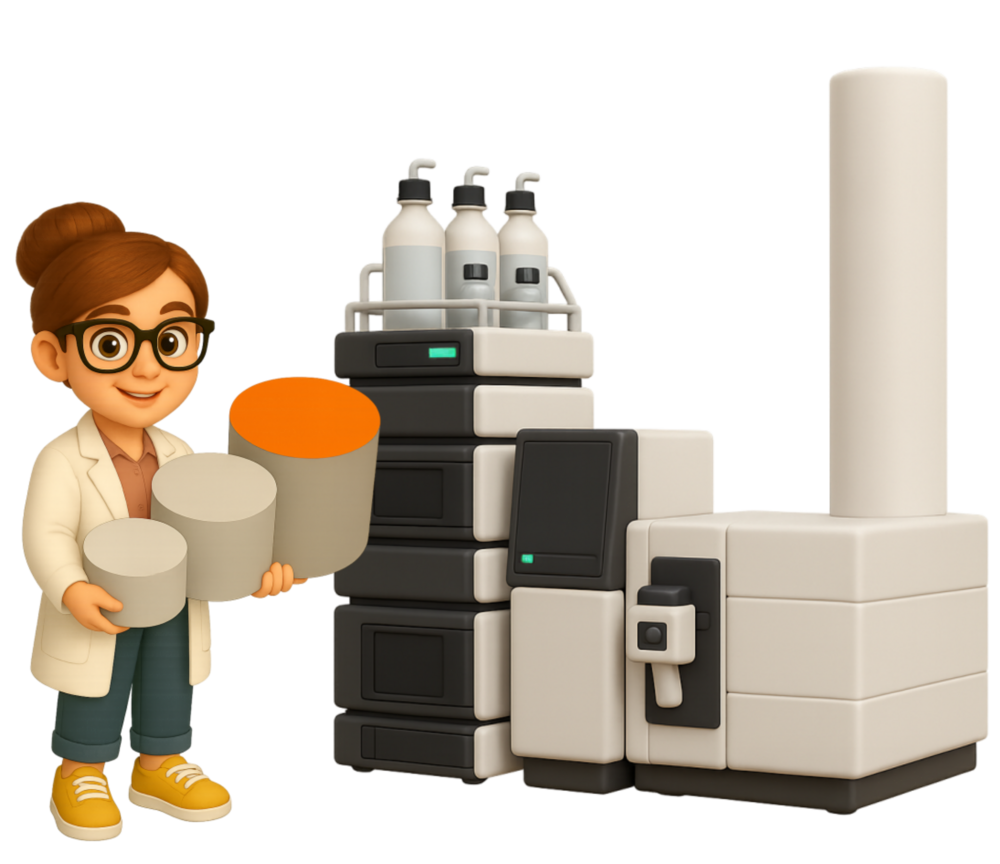
TOF(Time-of-Flight) 질량분석법? (TOF (Time-of-Flight) Mass Spectrometry)
입자가 특정 거리를 이동하는 데 걸리는 시간을 측정하여 입자의 질량을 결정하는 데 사용되는 방법.
주어진 전기장 또는 자기장에서 질량 대 전하 비율(m/z)이 서로 다른 입자가 서로 다른 속도로 이동한다는 원리에 의존함.
고정된 거리를 이동하는 데 걸리는 시간을 통해 비율(m/z)을 계산할 수 있으며 물질 식별 및 정량화에 중요한 정보를 제공.
TOF (Time-of-Flight) mass spectrometry is a method used to determine the mass of particles by measuring the time it takes for them to travel a specific distance.
It relies on the principle that particles with different mass-to-charge ratios (m/z) travel at different speeds in a given electric or magnetic field.
By measuring the time required to travel a fixed distance, the m/z ratio can be calculated, providing critical information for the identification and quantification of substances.
TOF 질량 분석법에는 정확하고 효율적인 작동에 중요한 여러 주요 단계
(TOF mass spectrometry involves several key steps that are critical for accurate and efficient operation)
𖤘 이온화(Ionization)
샘플은 일반적으로 전자 충격이나 레이저 탈착과 같은 방법을 통해 먼저 이온화되어 분자를 하전 입자(이온)로 변환.
The sample is first ionized, typically using methods such as electron impact or laser desorption, to convert molecules into charged particles (ions).
𖤘 가속(acceleration)
이온은 전기장을 사용하여 모든 이온에 대해 동일한 운동 에너지로 가속.
이 단계에서는 속도의 차이가 초기 운동 에너지가 아닌 이온의 질량 대 전하 비율로 인한 것임을 확인.
The ions are accelerated using an electric field, providing the same kinetic energy to all ions. At this stage, the difference in ion velocities is determined by their mass-to-charge ratio, rather than their initial kinetic energy.
𖤘 드리프트(Drift)
가속 후 이온은 드리프트 튜브라고 알려진 필드가 없는 영역으로 들어감.
질량 대 전하 비율에 따라 달라지는 속도로 이동하며, 가벼운 이온은 무거운 이온보다 빠르게 이동.
After acceleration, ions enter a field-free region known as the drift tube. They travel at speeds that vary depending on their mass-to-charge ratio, with lighter ions moving faster than heavier ions.
𖤘 감지(detect)
드리프트 튜브 끝에서 이온은 도착 시간을 기록하는 감지기에 영향을 줌.
각 이온이 드리프트 튜브를 통과하는 데 걸리는 시간을 사용하여 질량 대 전하 비율을 계산.
At the end of the drift tube, ions impact a detector that records their arrival times. The time each ion takes to pass through the drift tube is used to calculate the mass-to-charge ratio.
TOF 질량 분석법의 장점 (Advantages of TOF Mass Spectrometry)
높은 질량 정확도, 넓은 질량 범위 및 빠른 분석 시간을 포함.
단일 실험으로 전체 질량 범위 스캔을 수행할 수 있는 능력은 단백질체학에서 환경 분석에 이르기까지 다양한 응용 분야에서 매우 귀중한 도구.
TOF mass spectrometry offers high mass accuracy, a wide mass range, and fast analysis times.
The ability to perform a full mass range scan in a single experiment makes it an invaluable tool in diverse applications, ranging from proteomics to environmental analysis.

액체 크로마토그래피 (Liquid Chromatography, LC)
역할 (Role)
LC는 복합 시료에서 개별 화합물을 물리적, 화학적 특성에 따라 분리하여 MS 분석을 위한 순수 성분을 제공.
Liquid Chromatography (LC) separates individual compounds from complex samples based on their physical and chemical properties, delivering purified components for MS analysis.
구성 요소 (Components)
펌프 (Pump)
고압으로 이동상(용매)을 주입하여 시료를 컬럼을 통해 이동시킴.
일정한 유속을 유지하여 안정적인 분리를 지원.
Injects the mobile phase (solvent) under high pressure to transport the sample through the column, maintaining a stable flow rate.
샘플 주입기 (Sample Injector)
분석 샘플을 이동상과 함께 컬럼으로 주입.
자동 샘플러로 정확성과 반복성을 높힘.
Introduces the sample into the column along with the mobile phase, often using an autosampler for precision and repeatability.
컬럼 (Column)
이동상과 고정상 간의 상호작용으로 화합물을 분리하는 핵심 구성요소.
극성과 비극성 화합물의 분리에 따라 역상 크로마토그래피 또는 정상 크로마토그래피가 사용.
The core component that separates compounds through interactions between the mobile and stationary phases, depending on polarity.
검출기 (Detector)
LC 단계에서 분리된 성분을 감지하며, MS로 전달.
Detects the separated compounds in the LC phase and transfers them to the MS for further analysis.
이온화 (Ionization)
역할 (Role)
LC로 분리된 화합물을 질량 분석기에 전달하기 전에 기체 상태의 이온으로 변환.
TOF 분석에서는 이온화된 화합물을 정확히 측정하기 위해 이 단계가 매우 중요.
Ionization converts the separated compounds from LC into gas-phase ions before they enter the mass spectrometer.
This step is critical for accurate measurement in TOF analysis.
전기분무 이온화 (ESI, Electrospray Ionization): 극성 화합물 분석에 적합하며, 샘플을 전기장으로 미세 이온화합니다.
Electrospray Ionization (ESI): Suitable for polar compounds, creating fine ions using an electric field.
대기압 화학 이온화 (APCI, Atmospheric Pressure Chemical Ionization): 휘발성이 높은 화합물 분석에 사용되며, 고온에서 기체화된 샘플을 이온화합니다.
Atmospheric Pressure Chemical Ionization (APCI): Ideal for volatile compounds, ionizing samples after vaporization at high temperatures.

시간 비행형 질량 분석 (Time-of-Flight Mass Analyzer, TOF)
역할 (Role)
TOF 분석기는 질량 대 전하비(m/z)에 따라 이온을 분리하며, 비행 시간을 측정하여 분자량을 계산.
이 방법은 매우 높은 정확도와 분해능을 제공합니다.
Time-of-Flight (TOF) analysis separates ions based on their mass-to-charge ratio (m/z) by measuring their flight time.
This method provides extremely high accuracy and resolution.
작동 원리 (Working Principle)
이온 가속 (Ion Acceleration): 이온은 전기장을 통해 동일한 운동 에너지를 부여받음.
Ion Acceleration: Ions are accelerated through an electric field to the same kinetic energy.
비행 튜브 (Flight Tube): 이온은 비행 튜브를 통해 이동하며, 가벼운 이온이 더 빠르게 도착하고 무거운 이온이 느리게 도착.
Flight Tube: Ions travel through the flight tube, with lighter ions arriving faster and heavier ions arriving later.
검출 (Detection): 이온의 도착 시간을 측정하여 질량을 계산.
Detection: Arrival times are measured to calculate the mass of the ions.
특징 (Features)
고분해능 (High Resolution): TOF는 복잡한 혼합물에서도 화합물을 정확히 구분.
High Resolution: TOF accurately differentiates compounds in complex mixtures.
정확한 분자량 측정 (Accurate Mass Measurement): 높은 m/z 분해능으로 정확한 분자량을 제공.
Accurate Mass Measurement: Provides precise molecular weight determination with high m/z resolution.
데이터 처리 (Data Processing)
역할 (Role)
TOF 분석기를 통해 생성된 데이터를 해석하여 화합물의 질량, 구조, 농도를 식별 및 정량화 함.
LC-MS/MS TOF는 복잡한 샘플에서도 미량 화합물을 식별할 수 있는 높은 감도를 제공 함.
Data processing interprets the results from TOF analysis to identify and quantify the mass, structure, and concentration of compounds.
LC-MS/MS TOF offers high sensitivity for identifying trace compounds in complex samples.
주요 응용 분야 (Key Applications)
단백질체학 (Proteomics): 단백질과 펩타이드의 분석 및 정량화.
Proteomics: Analysis and quantification of proteins and peptides.
약물 대사 연구 (Drug Metabolism Studies): 신약 개발 과정에서 약물 대사 산물 분석.
Drug Metabolism Studies: Analysis of drug metabolites during pharmaceutical development.
환경 분석 (Environmental Analysis): 물, 토양, 공기 중 오염 물질 검출.
Environmental Analysis: Detection of pollutants in water, soil, and air.
식품 안전 (Food Safety): 식품 내 잔류 농약 및 불순물 분석.
Food Safety: Analysis of residual pesticides and impurities in food.
Liquid Chromatography Time-of-Flight Mass Spectrometry (LC-MS-MS TOF)를 생산 판매하는 주요 업체.
Agilent Technologies
제품명: 6546 LC/Q-TOF.
소비 전력: 약 3.5 kW. 정확한 소비 전력은 해당 제품의 사양서를 참고.
특징: 고분해능과 넓은 동적 범위를 제공하며, 대사체학 연구에 이상적.

Waters Corporation
제품명: Xevo G2-XS QTof
소비 전력: 약 3 kW
특징: 고감도와 신뢰성을 갖춘 분석기로, 다양한 응용 분야에 적합.

Shimadzu Corporation
제품명: LCMS-9050
소비 전력: 약 4 kW. 정확한 소비 전력은 해당 제품의 사양서를 참고.
특징: 고정밀 온도 제어 시스템으로 높은 질량 정확도와 안정성을 제공.

Thermo Fisher Scientific
제품명: Q Exactive HF-X
소비 전력: 약 3.5 kW. 정확한 소비 전력은 해당 제품의 사양서를 참고
특징: 고속 분석과 높은 분해능을 제공하며, 단백질체학에 최적화.

브루커(Bruker)
제품명: maXis II ETD.
소비 전력: 약 3.2 kW.
특징: 우수한 질량 정확도와 분해능을 갖춘 시스템으로, 복잡한 샘플 분석에 적합.

SCIEX
제품명: TripleTOF 6600+
소비 전력: 약 3.8 kW.
특징: 고속 데이터 수집과 넓은 동적 범위를 제공하며, 바이오마커 발견에 유용.

JEOL
제품명: JMS-T100LC AccuTOF
소비 전력: 약 2.5 kW.
특징: 고분해능과 빠른 데이터 수집을 특징으로 하며, 사용이 용이한 LC/MS 시스템.

PerkinElmer
제품명: QSight 420
소비 전력: 약 2.8 kW.
특징: 지속적인 이온 소스 기술로 높은 감도와 신뢰성을 제공.